
A missing tooth can change more than a photograph. You may start chewing on one side, avoid foods you used to enjoy, or feel self-conscious when you speak or smile. The good news is that missing tooth replacement options are not one-size-fits-all. The right choice depends on where the tooth was lost, the health of your gums and jawbone, your timeline, and what feels manageable for your budget.
For some people, replacing one tooth promptly is primarily about confidence. For others, it is about restoring comfortable chewing, protecting nearby teeth, or making a denture fit better. A thoughtful exam and conversation can turn a stressful decision into a clear, personalized treatment plan.
Why replacing a missing tooth can matter
Teeth work as a team. When one is missing, the surrounding teeth may gradually tip or drift into the open space. That can change your bite, create harder-to-clean areas, and place extra pressure on the teeth doing more of the chewing.
The jawbone beneath a missing tooth can also lose stimulation over time. Bone changes do not happen overnight, and not every gap creates an immediate problem. Still, preserving the space and supporting your bite early can often make future treatment simpler.
There are times when a missing back tooth may not need immediate replacement, particularly if it does not affect chewing or the stability of other teeth. Your dentist can help you weigh that option honestly rather than assuming every gap requires the same solution.
Missing tooth replacement options to consider
Modern dentistry offers several reliable ways to replace one or more teeth. Each approach has different advantages, care needs, and costs.
Dental implants
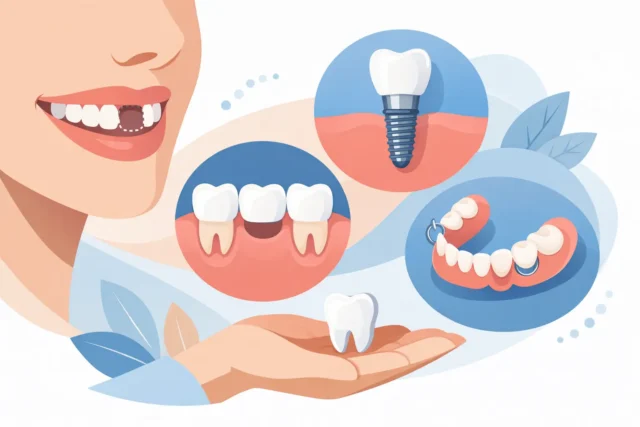
A dental implant replaces the root of a missing tooth with a small post placed in the jawbone. Once it has healed and integrated with the bone, it can support a custom crown. For a single missing tooth, an implant and crown can look, feel, and function very much like a natural tooth.
One of the main benefits is that an implant stands independently. The neighboring teeth usually do not need to be shaped down, as they do for a traditional bridge. Implants also help stimulate the jawbone where the tooth was lost.
Implants require healthy gums, adequate bone, and a healing period. If the tooth has been missing for a long time, bone grafting may be recommended before or during implant treatment. That adds time and cost, but it can make an implant possible and support a stronger long-term result. Smoking, uncontrolled diabetes, active gum disease, and certain medical conditions can also affect candidacy and healing.
For patients who want a fixed, long-lasting replacement and are comfortable with a surgical procedure, implants are often worth considering. They do require daily brushing, flossing or specialized cleaning around the implant, and regular dental visits.
Dental bridges
A dental bridge fills a gap by connecting a replacement tooth to crowns on the teeth beside it. The bridge is fixed in place, so it does not come out at night, and it can restore appearance and chewing relatively quickly.
A bridge can be an especially practical choice when the teeth next to the gap already need crowns because of large fillings, cracks, or existing damage. In that situation, restoring those teeth and replacing the missing tooth at the same time may be a sensible use of treatment.
The trade-off is that the supporting teeth must be prepared for crowns, even if they are otherwise healthy. Bridges also need careful cleaning underneath the replacement tooth. With good home care and routine checkups, a bridge can serve patients well for many years, but it may eventually need replacement.
Removable partial dentures
A removable partial denture replaces one or several missing teeth on a custom appliance that clips or rests around remaining teeth. It can be a cost-conscious way to restore multiple gaps, especially when a fixed bridge or several implants are not the right fit.
Partial dentures have improved in appearance and comfort, but they do take an adjustment period. They must be removed for cleaning, and some patients notice extra bulk at first. Their stability varies based on the design, the number and location of remaining teeth, and the health of the gums.
A partial denture may also be used as a temporary option while an extraction site heals or while you plan for implants. It is not always the final answer, but it can help you smile and eat more comfortably in the meantime.
Complete dentures and implant-supported dentures
When most or all teeth in an upper or lower arch are missing, a complete denture may restore the smile and everyday function. Conventional dentures rest on the gums and are removable. They are carefully designed to suit your mouth, facial support, and bite, but they can shift during eating or speaking, especially on the lower jaw.
Implant-supported dentures add stability by attaching a denture to strategically placed implants. Depending on the treatment design, the denture may snap in and out for cleaning or be fixed in place for a dentist to remove during maintenance visits. This option can improve confidence with chewing and speaking while helping preserve jawbone.
The best denture solution depends on bone volume, medical history, budget, and how much stability you need. A complete denture may be the most appropriate starting point for one person, while another may benefit from planning for implants over time.
How to choose the right treatment
The best replacement is not necessarily the most expensive one or the fastest one. It is the option that supports your health, goals, and daily routine.
Your dentist will look at the location of the missing tooth, neighboring teeth, bite alignment, gum health, bone levels, and signs of grinding or clenching. A missing front tooth has different cosmetic demands than a missing molar. Likewise, a bridge can be more appealing when adjacent teeth need crowns, while an implant may be preferable when neighboring teeth are healthy.
Your timing matters too. If a tooth has just been removed, you may be able to discuss immediate replacement options or a temporary tooth before you leave the office. If the tooth has been missing for years, imaging can show whether bone loss has changed the plan. There is no benefit to guessing. A clear evaluation provides the information needed to choose confidently.
Cost deserves a direct conversation as well. Treatment fees vary with the number of teeth involved, materials, imaging, bone grafting, sedation needs, and whether additional dental work is necessary first. Ask for a phased plan if that would help. Some patients begin with a removable option, then move to implant treatment when timing and finances allow. Patients without dental insurance can also ask about membership and payment options before treatment begins.
Caring for your replacement tooth
Every replacement needs maintenance. Implants and bridges are not immune to gum inflammation or plaque buildup, and dentures can collect deposits and irritate tissues if they are not cleaned correctly.
Brush twice daily, clean between teeth as recommended for your restoration, and keep regular professional visits. If you wear a removable partial or complete denture, clean it daily and follow your dentist’s instructions about removing it overnight. Report looseness, sore spots, clicking, changes in your bite, or pain promptly. Small adjustments are often easier to address before they become bigger problems.
Start with a plan that feels comfortable
Choosing among missing tooth replacement options can feel personal because it is personal. You deserve clear answers about what each treatment involves, how it will feel day to day, and what the long-term care will look like.
At Trail Ridge Dental, the goal is to help you make that decision without pressure. A supportive exam can clarify your options and create a plan that respects your comfort, health, schedule, and budget. Replacing a tooth is not only about closing a space. It can be a meaningful step toward eating, speaking, and smiling with greater ease again.