
Missing a tooth changes more than your smile. It can affect how you chew, how clearly you speak, and even how confident you feel in everyday moments. When patients ask about dental implants vs bridges, they are usually not looking for a textbook answer. They want to know which option will feel better, last longer, and make the most sense for their budget and lifestyle.
Both treatments can restore a gap and help protect your oral health. Both can look very natural. But they work in different ways, and the right choice depends on what is happening in your mouth now, not just what sounds best on paper.
Dental implants vs bridges: the basic difference
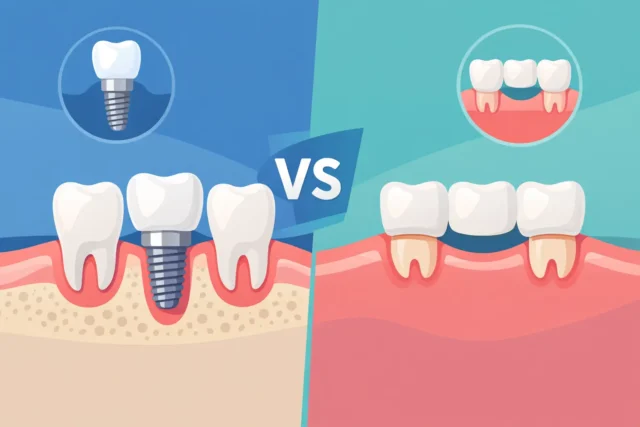
A dental bridge replaces a missing tooth by attaching an artificial tooth to the teeth on either side of the gap. In many cases, those neighboring teeth are shaped to support crowns, and the replacement tooth sits between them.
A dental implant replaces the missing tooth at the root level. A small titanium post is placed in the jawbone, where it functions like an artificial root. After healing, a custom crown is attached on top.
That difference matters. A bridge relies on nearby teeth for support. An implant stands on its own.
When a bridge may make more sense
A bridge can be an excellent solution for many patients, especially when speed and simplicity are priorities. If the teeth next to the gap already need crowns because of large fillings, cracks, or wear, a bridge can be an efficient way to restore the area.
Treatment time is often shorter with a bridge than with an implant. In many cases, once the teeth are prepared, impressions or scans are taken and the final bridge is placed soon after. For someone who wants a fixed replacement without a surgical procedure, that can be very appealing.
Cost can also be part of the decision. Upfront, a bridge is often less expensive than an implant. For families balancing multiple dental needs, that may be a practical factor.
Still, there are trade-offs. A traditional bridge usually requires removing some healthy structure from the neighboring teeth to make room for crowns. It also does not replace the root, which means the bone in the area of the missing tooth can shrink over time.
When an implant may be the better long-term choice
Dental implants are often recommended when preserving bone and protecting surrounding teeth are top priorities. Because the implant is placed in the jawbone, it helps stimulate the bone in a way that is closer to a natural tooth root.
An implant also does not depend on the teeth next to it. If those neighboring teeth are healthy, that is a major advantage. You are replacing the missing tooth without asking other teeth to carry the load.
Many patients also like how stable an implant feels. Once healed and restored, it is designed to function very much like a natural tooth. You do not remove it, and you do not have to work around supporting teeth the way you do with a bridge.
The trade-off is time. Implant treatment usually takes longer because the post needs time to integrate with the bone before the final crown is placed. Not every patient is ready for that timeline, especially if they want the space restored quickly.
How dental implants vs bridges compare in everyday life
From a day-to-day comfort standpoint, both options can work well. Most patients adjust nicely to either one, and both are designed to restore normal appearance and function.
Where the difference shows up is often in maintenance and long-term planning. A bridge has to be cleaned carefully underneath the replacement tooth, usually with floss threaders or other tools that help reach under the bridge. It is manageable, but it takes consistency.
An implant crown is brushed and flossed more like a natural tooth, although regular professional care is still essential. Good home care matters with both options, but some patients find implants easier to clean once everything is complete.
Chewing function can be strong with either treatment. That said, implant-supported restorations often feel more independent because they are anchored in the bone rather than connected across neighboring teeth.
Longevity: which one tends to last longer?
This is one of the most common questions, and the honest answer is that both can last many years with proper care. But they do not usually fail for the same reasons.
A bridge may need replacement if decay develops around the supporting teeth, if the cement seal breaks down, or if one of the anchor teeth develops a problem. The restoration is only as strong as the teeth holding it.
An implant cannot get a cavity, but it can still fail if the bone does not support it well or if gum disease and inflammation develop around it. That is why healthy gums, good oral hygiene, and routine checkups are so important.
In many cases, implants have the edge in long-term durability. But that does not mean they are automatically the right answer for every patient. A well-made bridge in a healthy mouth can serve beautifully for years.
Cost matters, and so does value
It is completely reasonable to ask about cost early in the conversation. For many patients, the real question is not just what each option costs today, but what it may cost over time.
A bridge often has a lower initial fee. An implant often costs more upfront because it involves surgical placement, healing time, and the final crown. But if an implant helps preserve bone and avoids placing stress on neighboring teeth, it may offer better long-term value in the right situation.
That does not make bridges the budget choice and implants the premium choice in every case. If a patient is not a good implant candidate or wants to avoid surgery, a bridge may be the most practical and appropriate treatment. Good dentistry is not about pushing one option. It is about matching the treatment to the person.
Who is a good candidate for an implant?
Implants work best when there is enough healthy jawbone to support them and when the gums are in good condition. Overall health matters too, since healing is part of the process. Some patients who have lost bone may still be candidates, but they may need additional treatment first.
Smoking, uncontrolled gum disease, and certain medical conditions can affect implant success. That does not always rule implants out, but it does mean a careful exam is important.
If you are anxious about dental procedures, it is worth saying that out loud. A supportive dental team can walk you through what to expect and help you feel comfortable at every step.
Who is a good candidate for a bridge?
A bridge may be a strong option if the teeth on either side of the gap are healthy enough to support it, or if they already need crowns. It can also be ideal for patients who want a fixed replacement but prefer to avoid oral surgery.
Bridges can be especially useful when treatment needs to move more quickly. If timing is important because of appearance, function, or scheduling, a bridge may fit your life better.
The key is making sure the supporting teeth and gums are healthy enough to carry the restoration well over time.
What your dentist looks at before recommending either option
This decision is rarely made by looking at the missing tooth alone. Your dentist will evaluate the health of the teeth next to the space, the condition of your gums, the amount of bone available, your bite, and your overall goals.
They will also ask practical questions. Do you want the most conservative option for neighboring teeth? Is lower upfront cost your main concern? Are you hoping for the longest-lasting solution possible? Do you want to avoid surgery? Those answers matter.
At a comprehensive family practice like Trail Ridge Dental, that conversation can be tailored to the full picture, including comfort, timing, and affordability, not just the technical side of treatment.
The right answer is personal
If you are deciding between dental implants vs bridges, there is no one-size-fits-all winner. Implants often offer the strongest long-term benefits for bone support and independence from nearby teeth. Bridges can be faster, effective, and very practical in the right case.
The best next step is not guessing. It is getting a clear exam and talking through your options with a dentist who will explain the pros, the limits, and what makes sense for your specific smile. A good replacement tooth should not just fill a gap. It should fit your life comfortably for years to come.