
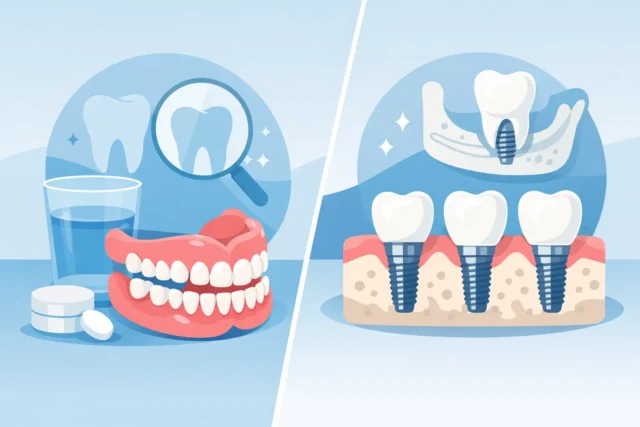
A missing tooth can change more than a smile. It can make a favorite meal harder to enjoy, make speaking feel less natural, and cause you to hide your teeth in photos. When deciding between dentures or dental implants, the right answer depends on your health, goals, budget, and the number of teeth you need to replace.
Both options can restore function and confidence. They are not interchangeable, though. Dentures are removable appliances that replace several or all missing teeth, while implants are replacement tooth roots placed in the jawbone and topped with a crown, bridge, or denture. A thoughtful conversation with your dentist can help you choose a solution that works for life as it is now, while also protecting your oral health for the years ahead.
Dentures or Dental Implants: The Main Difference
Dentures sit on top of the gums. A full denture replaces all teeth in an upper or lower arch, while a partial denture fills spaces when some healthy natural teeth remain. Modern dentures can look natural and improve chewing and speech, especially when they are carefully fitted and adjusted.
Dental implants work differently. A small titanium post is placed in the jawbone, where it gradually bonds with the bone. After healing, the post can support an individual crown, a bridge, or a full arch of replacement teeth. Because implants are anchored in the jaw, they generally feel more like natural teeth than a removable appliance.
That distinction affects nearly every part of the decision: daily care, stability, treatment timeline, upfront cost, and long-term maintenance. Neither choice is automatically best for every patient.
When Dentures May Be a Good Choice
Dentures remain a practical, effective option for many people. If you are replacing many teeth, want a non-surgical treatment, or need an affordable way to restore your smile sooner, dentures may be the right fit. They can also be a helpful temporary solution while you consider future implant treatment.
A conventional full denture is typically held in place by the natural shape of the gums and, for an upper denture, suction against the palate. Partial dentures usually use clasps or precision attachments around remaining teeth. Some patients adapt quickly, while others need time to become comfortable with the feeling of a removable appliance.
The most common concern with dentures is movement. Lower dentures, in particular, may shift during meals or conversation because there is less surface area for support. Adhesives can help in some cases, but they do not create the secure feeling of teeth anchored in the jaw.
Dentures also need ongoing attention. Your gums and jawbone naturally change shape after teeth are lost, which can loosen the fit over time. Relines, adjustments, repairs, and eventual replacement are normal parts of denture care. Taking dentures out at night, cleaning them daily, and allowing the gums to rest helps keep the mouth healthy.
For patients who have lost teeth recently, an immediate denture may be placed after extractions so they do not have to go without teeth during healing. It is a useful option, but it often requires adjustments as the gums heal and change shape.
When Dental Implants May Be Worth Considering
Implants are often a strong choice for patients who want a stable, long-lasting replacement that does not come out for cleaning. A single missing tooth can be restored with one implant and a custom crown. Several missing teeth may be replaced with implant-supported bridges, and a full arch can sometimes be secured using a small number of strategically placed implants.
Because implants stimulate the jawbone when you chew, they can help reduce the bone loss that often follows tooth loss. This is one of their biggest long-term advantages. When a tooth root is missing, the bone in that area no longer receives the same chewing forces and can gradually shrink. That change may affect facial support and make future restorations more complex.
Many patients also appreciate the everyday convenience of implants. An implant-supported crown is brushed and flossed much like a natural tooth. Implant-supported dentures can be removable or fixed, depending on the treatment plan. Even a removable denture becomes far more secure when it snaps onto implants, which can make eating and speaking more comfortable.
Implants do require a surgical procedure and healing time. Some patients may be candidates for a restoration on the same day as implant placement, but others need several months of healing before the final tooth is attached. The timeline depends on the location of the implant, the quality of the bone, the health of the gums, and whether an extraction or bone graft is needed first.
Cost Is More Than the Initial Price
It is understandable to focus on cost. Dentures usually have a lower initial cost than implants, particularly when replacing a full arch of teeth. For someone who needs an immediate solution or is working within a limited budget, that difference can be meaningful.
However, the initial fee does not tell the full story. Dentures may need periodic relines, repairs, or replacement as the mouth changes. An implant restoration also has maintenance needs, but the implant itself can last for many years with healthy gums, consistent home care, and regular dental visits. Crowns, bridges, and denture components supported by implants may eventually need repair or replacement.
The best financial choice is the one that is realistic for you and supports your health goals. Some patients choose dentures first and plan for implants later. Others decide that the added stability and bone-preserving benefits of implants justify a higher investment from the start. Your dental team can explain expected costs clearly, discuss phased care when appropriate, and help you explore payment and membership options.
Your Oral Health Helps Determine the Right Option
Healthy gums and adequate jawbone are especially important for implant treatment. Periodontal disease needs to be controlled before implants are placed, and some patients need bone grafting to create a stable foundation. Conditions such as uncontrolled diabetes, heavy tobacco use, certain medications, or a history of radiation treatment can also affect healing. These factors do not always rule out implants, but they deserve careful planning.
Dentures have their own health considerations. Remaining teeth that support a partial denture need to be strong and well cared for. Gum irritation, sore spots, and fungal infections can occur if dentures are not cleaned properly or are worn around the clock. A loose denture should not simply be tolerated. It should be examined and adjusted.
During an evaluation, your dentist will look at your gums, bite, remaining teeth, bone levels, and medical history. Digital imaging helps show what is happening beneath the gumline. Just as important, your dentist should ask how you want your teeth to function. Do you miss eating crisp apples? Are you concerned about a denture moving during conversation? Do you need a treatment plan that fits a specific timeline? Those answers matter.
Implant-Supported Dentures Offer a Middle Ground
For many people missing most or all of their teeth, implant-supported dentures provide a helpful balance between affordability and stability. Instead of placing an implant for every missing tooth, a dentist may use several implants to anchor a full denture.
A removable implant-supported denture can snap into place for a secure fit, then be taken out for cleaning. A fixed full-arch restoration stays in the mouth and is removed only by a dental professional for maintenance. The right design depends on bone availability, bite forces, hygiene needs, and personal preference.
This approach can be especially appealing to patients who dislike the movement of conventional dentures but do not need or want an implant crown for each tooth. It can also reduce coverage of the palate for some upper-denture patients, allowing food temperature and flavor to feel more natural.
Daily Care Is Different, but Necessary Either Way
Dentures should be removed and cleaned daily with products made for dentures. Regular toothpaste can be too abrasive. Brush your gums, tongue, and any remaining natural teeth, and store dentures safely when they are not being worn. Never use hot water, which can warp the appliance.
Implants cannot get cavities, but the surrounding gums and bone can still develop infection. Brush thoroughly, clean between teeth or beneath implant bridges as directed, and keep regular hygiene appointments. Bleeding gums, bad breath, discomfort, or a change in how an implant restoration feels should be checked promptly.
Whether you choose dentures, implants, or an implant-supported option, routine care protects the investment you have made in your smile.
A Choice That Should Feel Personal
The goal is not to steer every patient toward the same treatment. Some people are happiest with a well-made denture that restores their smile quickly and comfortably. Others value the security and natural feel of implants enough to pursue the added time and expense. Many choose a combination approach.
At Trail Ridge Dental, treatment planning begins with listening. For patients across Northern Colorado, that means making room for practical questions about comfort, cost, anxiety, timing, and long-term care, not just discussing the technical details.
If you have been living with missing teeth or struggling with an older denture, a consultation can replace uncertainty with a clear plan. The next step may be as simple as learning what your mouth needs to make meals, conversations, and smiles feel like your own again.