
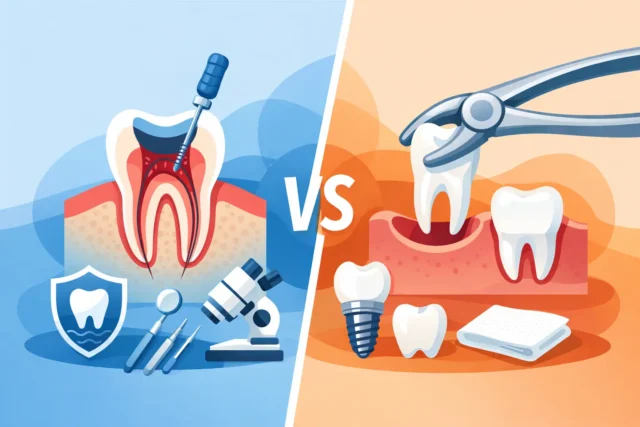
That sharp toothache that keeps you awake at 2 a.m. usually leads to one big question at the dental office: root canal vs extraction. If a tooth is badly infected, cracked, or causing constant pain, both treatments can solve the immediate problem. The better choice depends on what condition the tooth is in, how much healthy structure is left, your budget, and what you want your smile to look and feel like long term.
For many patients, this decision feels stressful because they are not just choosing a procedure. They are choosing between saving a natural tooth or removing it and planning for what comes next. A good dentist will walk you through that choice clearly, without pressure, and explain the trade-offs in a way that makes sense for your health and your life.
Root canal vs extraction: the basic difference
A root canal is designed to save your natural tooth. During treatment, the infected or damaged tissue inside the tooth is removed, the canals are cleaned and sealed, and the tooth is usually restored with a filling or crown. The outside of the tooth stays in place, which helps preserve your natural bite and appearance.
An extraction removes the tooth entirely. This may be the best option when a tooth is too damaged to repair, the infection is severe, there is not enough tooth left to support a restoration, or keeping the tooth would not be predictable. Once the tooth is removed, you and your dentist may discuss replacing it with an implant, bridge, or partial denture depending on the location of the tooth and your goals.
When a root canal is often the better option
In general, dentists prefer to save a natural tooth whenever it is realistic and healthy to do so. Your natural teeth are designed to work together, and keeping them usually helps with chewing, alignment, and jaw function.
A root canal is often a strong choice when the infection is inside the tooth but the tooth itself can still be restored. If the roots are healthy, the surrounding bone is stable, and the tooth has enough structure left for a crown or filling, saving it can be the simplest long-term answer. Many root canal treated teeth function well for years with proper care.
There is also a comfort factor people do not always expect. Patients often assume extraction will be easier because the tooth is gone, but removing a tooth can create its own healing period and may lead to more decisions later. Saving the tooth can mean less disruption to your bite and fewer restorative steps afterward.
Front teeth and highly visible teeth are another area where root canals often make sense. Preserving the natural tooth can help maintain the look of your smile, especially when the tooth can be restored attractively.
When extraction may make more sense
Sometimes a tooth simply cannot be saved in a predictable way. If decay extends too far below the gumline, the tooth is fractured deep into the root, severe bone loss is present, or repeated treatment has failed, extraction may be the more responsible option.
An extraction can also be appropriate when keeping the tooth would require extensive treatment with a poor prognosis. In that case, removing the tooth and replacing it strategically may be more cost-effective and healthier over time.
There are practical situations too. Some patients have limited time, a pressing infection, or financial constraints that affect the decision. While the long-term plan still matters, immediate relief and safety matter too. A trustworthy dental team should help you balance the urgent need with the bigger picture.
Pain, recovery, and what patients usually feel
One of the biggest misconceptions in the root canal vs extraction conversation is that root canals are more painful. In reality, modern root canal treatment is typically done with local anesthesia and is often no more uncomfortable than getting a filling. For many people, the relief from the infection is the biggest change they notice.
Extractions are also performed with anesthesia, and patients should be kept comfortable during the procedure. The difference often shows up after treatment. Once a tooth is removed, the body has to heal the socket. That can mean soreness, swelling, and a few days of being careful with eating and activity. If the extraction is surgical or the tooth is broken below the gumline, recovery can be more involved.
That does not mean extraction is the harder treatment every time. A straightforward extraction may heal smoothly, while a severely infected tooth treated with a root canal can still be tender for a short period. This is one of those areas where it depends on the tooth, the infection, and the complexity of treatment.
Cost now versus cost later
Many patients understandably focus on the upfront fee. An extraction can cost less at the initial visit than a root canal and crown. But that is only part of the financial picture.
If you remove a tooth and do not replace it, nearby teeth can drift, your bite can change, and chewing may become less comfortable. If you do replace it, the total cost may include the extraction plus a dental implant, bridge, or denture. In many cases, that long-term cost ends up being higher than saving the tooth.
On the other hand, if a tooth has a poor chance of lasting even after a root canal and crown, investing in saving it may not be the best value. This is where an honest exam matters. You want to know not only what can be done, but what is likely to work well for the long run.
For families and uninsured patients, affordability is a real part of the decision. Flexible payment options, transparent treatment planning, and membership savings can make needed care feel more manageable instead of overwhelming.
The long-term effects of losing a tooth
A missing tooth is not always just a cosmetic issue. Teeth help keep each other in position. When one is removed, neighboring teeth may shift into the space over time. Opposing teeth can also move because they no longer have contact where they once bit together.
The jawbone in that area can begin to shrink as well. Natural tooth roots help stimulate the bone. Without that stimulation, bone loss can happen gradually. This is one reason implants are often recommended after extraction when appropriate. They help restore function and support the bone more like a natural root.
That said, not every missing tooth creates the same level of concern. Losing a wisdom tooth is very different from losing a molar that does most of your chewing or a front tooth that affects your smile. The tooth location matters.
How dentists decide between saving and removing
A careful exam tells the real story. X-rays, the depth of decay or fracture, gum and bone health, symptoms, and bite forces all help determine whether a tooth is a good candidate for root canal treatment or whether extraction is the wiser route.
Your overall health matters too. If you grind your teeth heavily, have advanced periodontal disease, or have had repeated issues with the same tooth, your dentist may be more cautious about recommending treatment aimed at saving it. If the tooth is strategically important and has a strong foundation, the recommendation may lean toward preserving it.
This is not a one-size-fits-all decision. Two patients can have similar pain but need very different treatment. That is why a rushed answer rarely serves patients well.
What to ask if you are choosing between the two
If you are deciding between a root canal and extraction, ask a few direct questions. Is the tooth restorable? What will it need after a root canal? If it is extracted, what are the replacement options and when should that happen? What does the long-term prognosis look like in either case?
Those questions can quickly shift the conversation from fear to clarity. Instead of focusing only on getting out of pain today, you can make a decision that supports your comfort, budget, and oral health down the road.
At a family-focused practice like Trail Ridge Dental, that kind of conversation should feel straightforward and supportive. You deserve an explanation that respects both the clinical facts and the real-life concerns that come with treatment decisions.
The best choice is the one that protects your future smile
When root canal vs extraction comes up, the goal is not to push one treatment over the other. The goal is to remove infection, relieve pain, and choose the option that gives you the healthiest and most predictable result. Sometimes that means saving the tooth. Sometimes it means removing it and rebuilding wisely.
If your tooth is hurting, cracked, or infected, try not to wait for it to become an emergency that leaves you with fewer options. The sooner you get it evaluated, the more likely you are to have a calm, practical path forward and a smile that keeps working for you long after the pain is gone.